What I bring
Technology Leadership
Led onshore/offshore development teams - peaking at 40+ while six applications were migrated at once - and owned enterprise platforms, budgets and vendors at TD Bank. This one rests on TD, not on this portfolio.
The record →Enterprise Architecture
Platforms that scale and stay governable: an anti-money-laundering system still in production after 20 years, and one shared platform under everything here.
The architecture map →AI Engineering
Production AI: agentic tool loops, a hard boundary around untrusted workers, grounded answers, and frontier vs. self-hosted models chosen per workload.
The AI tool loop →Intelligent Automation
Automate the repeatable; keep humans where a wrong answer is expensive. At TD: enterprise workflow automation on Pega as development manager, then 50+ automations and 83% fewer incidents as operations manager. Here: a pool that scores itself and a job search automated from finding the company to tracking the application.
Tourney → GetSeen →Product & Requirements Thinking
Owns requirements, operating model and pricing, not just code. Product owner of TD's Data Retention and Disposition Catalogue and evidencing tool; the product plan behind GetSeen.
Product thinking →Production Engineering & Operations
How systems are run, not just built: separate environments, gated releases, an audit trail, and one control plane with an AIOps loop over every deploy.
Control Tower →One career. Every layer of technology.
Build
Developer, then architect and team lead. Architected NAMES, still live 20+ years on.
2010 - 2019Lead
Development manager. Onshore/offshore teams, budget and vendors; 40+ people at peak, migrating six applications at once.
2019 - 2023Operate
9 enterprise applications, 1.3M+ documents a month; then automation operations across 15+ business lines.
2023 - 2026Govern
Enterprise data management: product ownership and audit-ready evidence.
2026 -Transform
Solutions architect. Every layer, hands-on again, with AI agents implementing under my spec and review.
The proof: three applications, one platform
These aren't four unrelated demos. Three applications are the proof; underneath them is one engineering platform that builds, secures, deploys and runs all of them.
- TourneyProduction · 40+ users, March 2026
- RunwayPOC
- GetSeenSIT
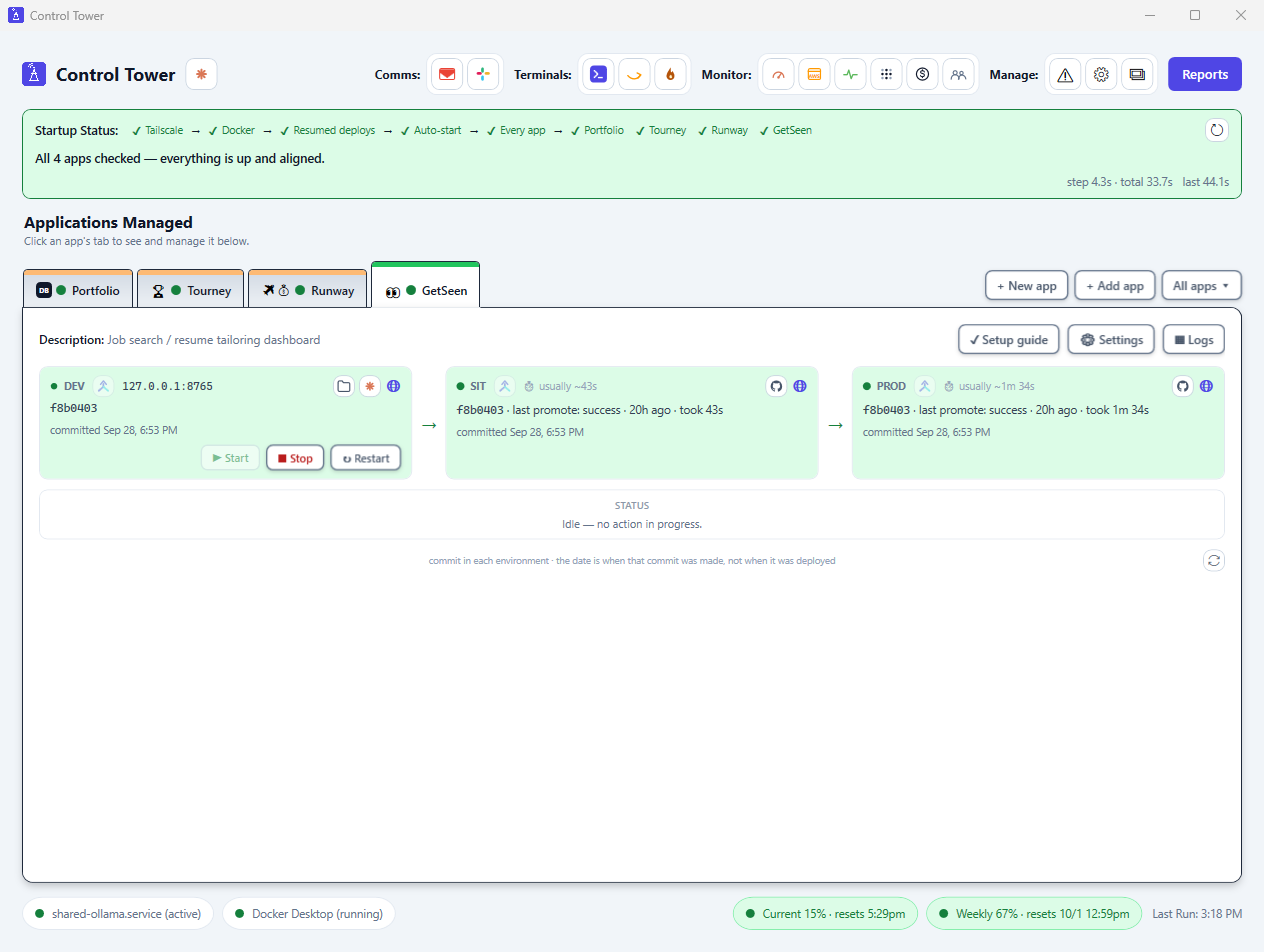
- Control TowerOperating plane + AIOps · governs every deploy
Pick one ↓

- Problem
- A March Madness pool ran on paper and spreadsheets for 15+ years. Scoring by hand took hours after every round.
- Decision
- Automate the scoring and the reconciliation; keep the draft, the trash talk and the money human.
- What I built
- A web app that scores itself from live game results, with a seed-capped draft and two AI recap writers compared head to head.
- Result
- In production with 40+ real participants through the March 2026 tournament. 950+ tests against a real database.
- Where AI stops
- The AI writes the daily recap. It never touches a score - scoring is deterministic code fed by live results.
- What it proves
- Business problem → requirements → automation → application → live production system.

- Problem
- When my own job was eliminated, "am I financially safe?" needed my accounts, my taxes and real market history - not a generic calculator's guess.
- Decision
- Correct first, then pretty, then fast. The numbers come from tested code before any AI is allowed near them.
- What I built
- A retirement simulator: 5,000 Monte Carlo paths in under two seconds, a reference engine that proves the fast one, and an AI advisor grounded in real documents.
- Result
- The tool I use for my own decision. 397 tests in CI. All data stays in the browser.
- Where AI stops
- The advisor narrates and answers questions. It is never allowed to compute a number.
- What it proves
- Domain correctness → architecture → AI boundaries → deterministic computation → RAG → agentic interaction.

- Problem
- A real job search means finding the right companies, screening each role, tailoring every application and tracking it all. Almost nobody has time to do that well.
- Decision
- Automate the tailoring, never the click. The tools that auto-submit have the worst reviews in the category.
- What I built
- A job-search platform on a reusable agent loop: company discovery, fit screening, resume and cover-letter tailoring, a pipeline tracker - with frontier and self-hosted models as interchangeable workers.
- Result
- In integration testing, used in my own search. Production held back on purpose; a cross-tenant data bug found in security review and closed first.
- Where AI stops
- The AI can propose work. It never submits an application - every one still requires my own click.
- What it proves
- Agentic AI → tool calling → worker boundary → human approval → reusable AI infrastructure → product thinking.
Control Tower - the operating plane
Not a fourth application - the console the three applications and this site are run from. Live status per environment; one governed path to production; a fail-closed gate that refuses a release if any check is missing, pending or failed; an audit trail nobody can edit; and an AIOps loop - a failed release is investigated by AI, which diagnoses it and proposes a fix I approve or dismiss. It also adds new apps (Dev and SIT set up for me, Prod stays my click). What it proves: operations → deployment governance → automation → AIOps → auditability → platform thinking. See Control Tower →
- AI Tool Loop - the queue and tool-calling loop under every AI feature.
- AI Worker Boundary - the GPU host pulls its own work; nothing connects in.
- Login Security - password and session primitives, written once.
- AI Answers (RAG) - answers grounded in real documents, citations checked.
- CI/CD - five gates, DEV → SIT → PROD, human-triggered production.
- Worker infrastructure - DGX Spark open-weight models beside metered frontier calls.
When the same problem shows up twice, it becomes a component every application uses.
How I work with AI
Not autocomplete. The same division of labor I used with a development team: a written spec, a defined architecture, a review gate nothing skips.
- Business problem and requirements
- Architecture and constraints
- Security boundaries
- Acceptance criteria and tests
- Implementation and refactoring
- Test creation
- Investigation and debugging
- Documentation
- Architecture and code review
- Testing and security
- Deployment
- Production behavior
How it all fits together
Architecture Map — applications, platform, pipeline One shared platform for AI, security, deployment and operations under every application. Click any box for the mechanism behind it.